
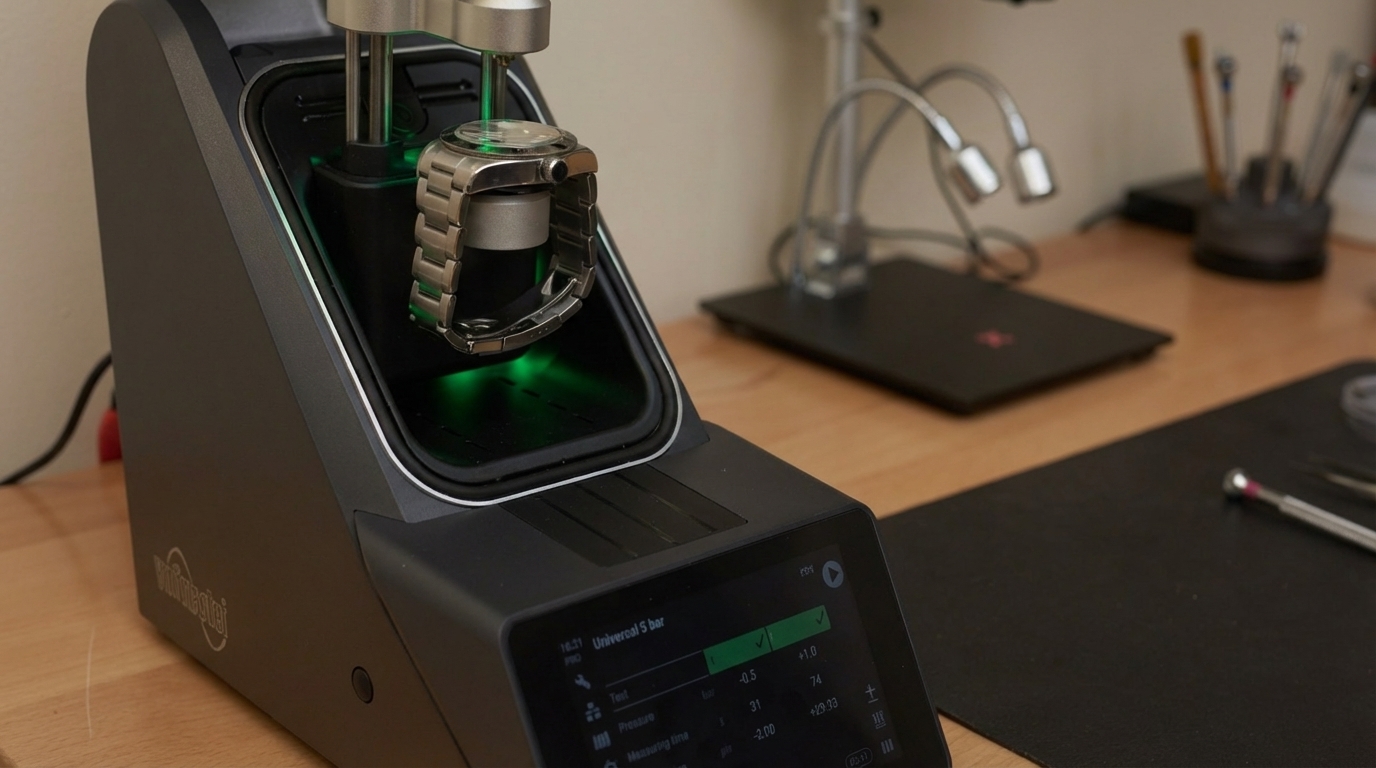
Quick Answer: A watch pressure test checks whether your watch’s seals are still intact and can keep water out. You need one any time the case has been opened, including after a battery replacement, and before using your watch in water.
Key Takeaways
- A pressure test verifies that your watch’s gaskets and seals are still doing their job.
- Any time the case is opened, including for a battery swap, the water resistance rating is no longer guaranteed.
- Divers and swimmers should have their watches pressure tested at least once a year.
- Skipping the test can lead to moisture damage, condensation, and expensive movement repairs.
- A qualified watchmaker can perform a pressure test quickly and at a reasonable cost.
You send your watch in for a battery replacement. The service comes back quickly, the watch looks fine, and you think nothing of it. What you may not know is that opening the case back is enough to compromise the water resistance seal, and without a pressure test afterward, there is no way to confirm it was restored correctly.
A watch pressure test is one of the most important steps in any service that involves opening the case. For divers, swimmers, and anyone who wears a quality timepiece in or around water, understanding what it is and when you need one is essential to protecting the watch long term.
What Is a Watch Pressure Test?
A pressure test checks whether a watch’s seals are still effective at keeping water out. The case, crown, case back, and crystal all rely on rubber or synthetic gaskets to create a watertight barrier. Over time, those gaskets dry out, compress, or get disturbed during service. A pressure test tells you whether the seals are still doing their job before you find out the hard way.
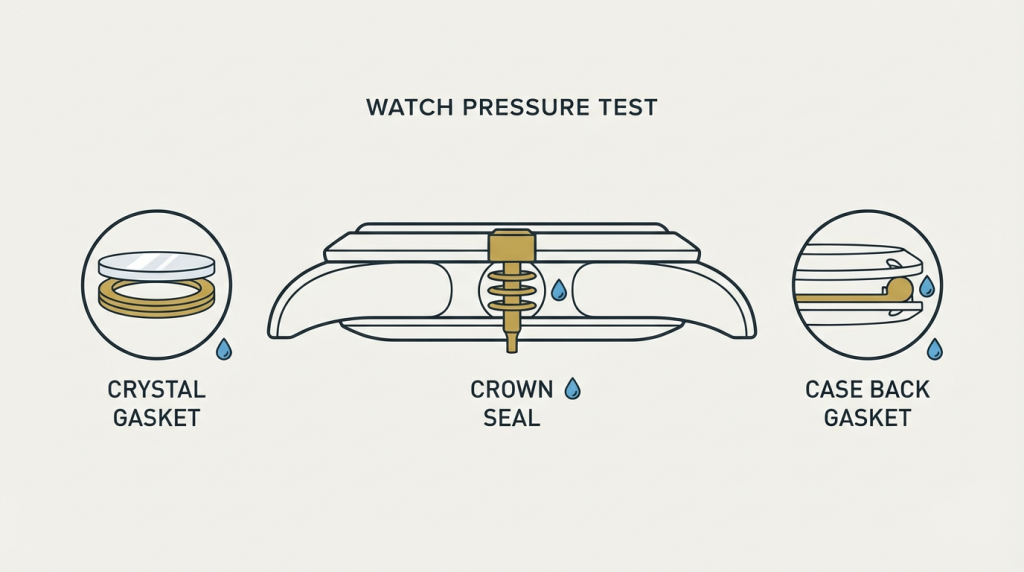
The test is performed using specialized equipment that either applies air pressure to the watch or submerges it under controlled conditions. A qualified watchmaker reads the results and can tell you whether the seals need replacing before any water exposure.
Dry Pressure Test vs. Wet Pressure Test
There are two main methods. A dry pressure test uses compressed air to pressurize the watch case without getting it wet. It is the most common method and works well for most situations. A wet pressure test actually submerges the watch in water under pressure, which is closer to real-world conditions and is typically used for dive watches rated to higher depths. For most everyday water-resistant watches, a dry test is sufficient.
How Water Resistance Ratings Actually Work
The numbers on your watch dial, whether in ATM, bar, or meters, are often misunderstood. They come from laboratory conditions, not real-world use. A watch rated to 30 meters (3 ATM) is splash-resistant at best. It is not safe for swimming. A rating of 100 meters is generally considered safe for recreational swimming. Dive watches typically start at 200 meters and above.
More importantly, those ratings apply when the watch leaves the factory. Every time the case is opened, the rating resets to unknown. Gaskets can be disturbed, pinched, or simply forgotten during reassembly. Without a pressure test afterward, you have no way of knowing whether your watch still meets its original rating.
The table below shows what each common rating actually means for everyday use.
Water Resistance Ratings at a Glance
| Rating | Suitable For | Not Suitable For |
|---|---|---|
| 30m / 3 ATM | Splashes, rain | Swimming, showering |
| 50m / 5 ATM | Short shallow swims | Snorkeling, diving |
| 100m / 10 ATM | Swimming, snorkeling | Scuba diving |
| 200m+ / 20 ATM+ | Scuba and recreational diving | Saturation diving (professional) |
When Do You Need a Watch Pressure Test?
There are several situations where a pressure test is not optional, it is necessary.
- After a battery replacement. This is the most common trigger and the most overlooked. Opening the case back disturbs the gasket every time. If the shop that replaced your battery did not perform or offer a pressure test, your water resistance rating is no longer reliable. Learn more about watch battery replacement in Atlanta and what a proper service includes.
- After any case opening or service. Full service, crystal replacement, crown repair, anything that requires opening the watch should be followed by a pressure test.
- After an impact or drop. A hard knock can shift or crack a gasket without any visible damage to the case.
- After crown damage. The crown is one of the most vulnerable points for water entry. If the crown has been bent, forced, or operated while submerged, get a pressure test before the next water exposure.
- Annually for divers and regular swimmers. Even without any service, gaskets degrade over time. An annual pressure test is standard practice for anyone who regularly wears their watch in water.
If any of these apply to your watch, bring your watch for a pressure test to our Johns Creek store or call 770-442-9854 to speak with a certified watchmaker.
What Happens During a Pressure Test?
The process is methodical and typically takes only a few minutes once your watch is with the technician, but each step serves a specific purpose.
- The watchmaker inspects the crown and case back visually before testing, looking for signs of wear, improper seating, or damage to the gasket channel that would cause an obvious failure regardless of pressure applied.
- The watch is placed in a calibrated pressure testing machine.
- For a dry test, compressed air is applied to the case and held for a set period. Any drop in pressure indicates a leak path, even one too small to see.
- For a wet test, the watch is submerged under controlled pressure and monitored for air bubbles or deformation of the case, which replicates conditions closer to actual diving depth.
- The watchmaker reads the results and advises on whether gasket replacement is needed before the watch is returned to you.
What a Failed Test Reveals
A failed pressure test is useful information. It means you caught the problem before water did. The most common causes of failure are worn or dried gaskets, a case back that was not seated correctly, or a compromised crown seal. Gaskets are consumable components and are typically replaced as part of any complete service. If your watch has not had its gaskets changed in several years, a failed test is often a sign that a full service interval is approaching, not just a one-off fix. The alternative is discovering the failure through a foggy watch face or visible condensation under the crystal, by which point the damage is already done.
What Happens If You Skip the Pressure Test?
The short answer: moisture gets in, and moisture is one of the most destructive forces a watch movement can encounter.
Even a small amount of water vapor inside the case can cause corrosion on the movement parts, rust on the mainspring, and damage to the dial. The condensation you see under the crystal is a sign that water has already been inside for long enough to evaporate and collect. By that point, you are likely looking at a full movement service rather than a simple gasket replacement. You can read more about repairing humidity and water damage in watches and what that process involves.
The cost of a pressure test is a fraction of what water damage repair costs. For a deeper look at what water can do to a watch over time, see our guide on water damage and watches.
Where to Get a Watch Pressure Test
Not every jeweler or watch shop has the right equipment. A proper pressure test requires a calibrated testing machine, and the results are only meaningful if the technician knows how to interpret them and replace gaskets correctly.
Your best options are an authorized service center for your brand or a qualified independent watchmaker with the right equipment. When you call ahead, ask two things: whether they perform pressure testing as part of battery or service work, and whether they replace gaskets at the same time. If the answer to either is no, it is worth finding a shop that does.
At It’s About Time, pressure testing is part of how we approach any service that involves opening the case. It is not an add-on, it is just the right way to do the job. Come into our Johns Creek store or call 770-442-9854 to speak with a certified watchmaker.
Frequently Asked Questions
Does a pressure test need to be done by an authorized service center?
Not necessarily, but the technician does need proper equipment and the knowledge to act on the results. An authorized service center will use manufacturer-specified pressure tolerances and replacement gaskets. A qualified independent watchmaker with calibrated testing equipment can also perform a reliable test. What matters most is that the shop replaces gaskets as part of the process, not just checks the seals and hands the watch back.
Can any watch be pressure tested?
Most watches with a water resistance rating can be pressure tested. Dress watches with very low ratings (30m or less) are sometimes excluded because applying test pressure could stress the seals. Your watchmaker can advise based on your specific model.
How often should I pressure test my dive watch?
Once a year is the standard recommendation for watches worn regularly in water. If you dive frequently or expose your watch to saltwater, some manufacturers recommend testing every six months. Always test after any service, regardless of when the last test was done.
Does a pressure test check the crown too?
Yes. The crown and its sealing tube are tested along with the rest of the case. The crown is one of the most common points of water entry because it involves a moving part passing through the case wall. On watches with a screw-down crown, the seal depends entirely on the crown being fully engaged before water exposure. A pressure test will detect a compromised crown seal, but it cannot compensate for a crown that was left unscrewed.
Is a pressure test the same as a water resistance test?
They refer to the same thing. Some shops use the term water resistance test, others say pressure test. What matters is that the test uses calibrated equipment to apply and measure pressure against the case, rather than simply submerging the watch without any means of measuring pressure or detecting a failure.
Ready to restore your timepiece with precision and care? Our experienced technicians handle everything from simple tune-ups to full mechanical overhauls. Let us bring your watch back to life.