
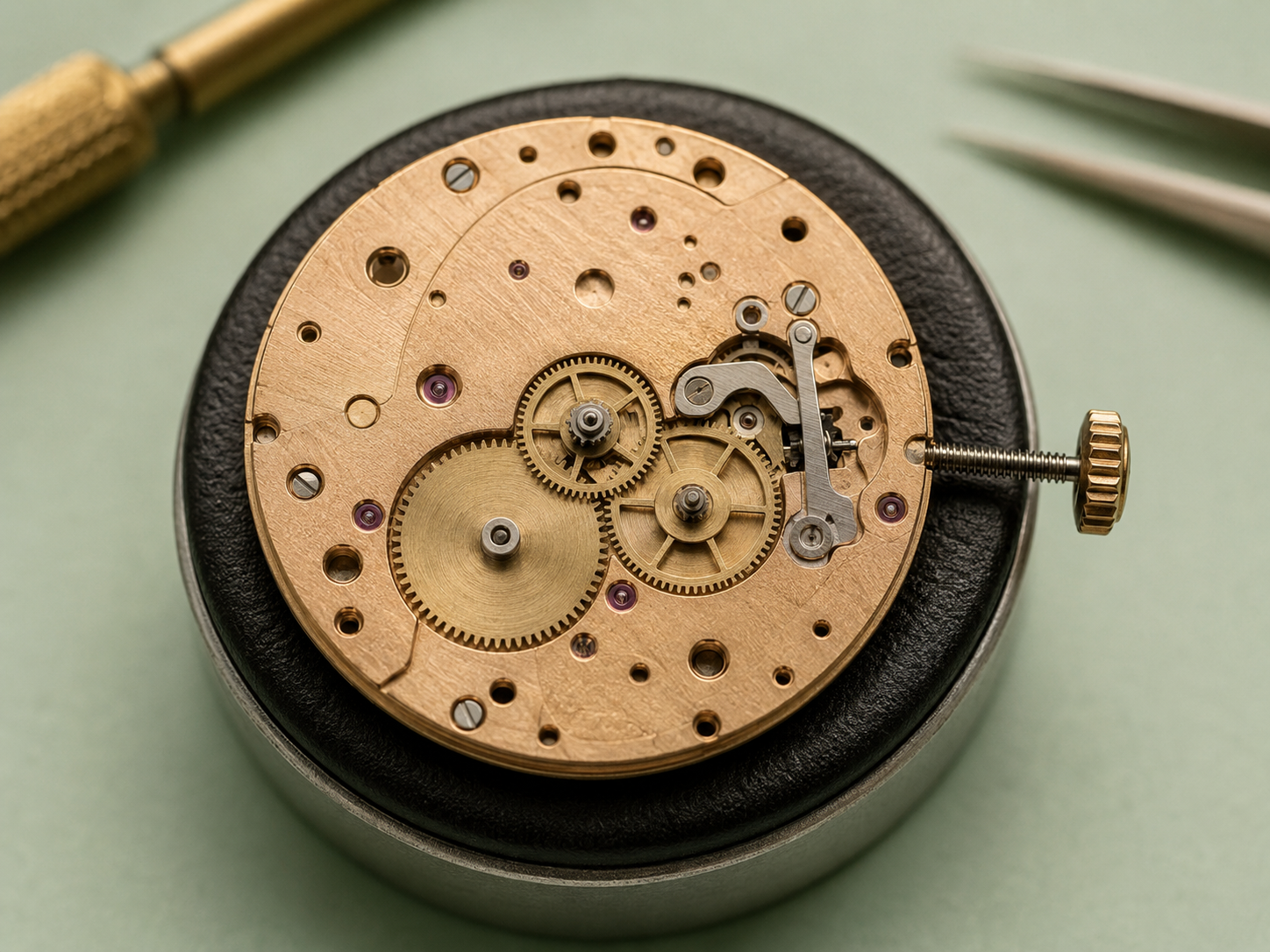
Most watch owners never see what sits behind the dial. When a watchmaker lifts it off during service, the movement is exposed: the gear train, balance wheel, mainspring barrel, and dozens of other components. It is one of the most skill-dependent steps in any watch service, and cutting corners here can create problems that do not show up until weeks later.
What the Dial Actually Does Inside Your Watch
The dial is more than a display surface for the time. It sits directly on top of the movement and is secured by two small metal pins called dial feet. These pins press into corresponding holes in the movement’s main plate, and small screws or spring-loaded levers lock them in place.
That connection keeps the dial aligned so the hands point to the correct markers, while also acting as a physical barrier between the movement and the crystal above. Once the dial comes off, the cannon pinion, hour wheel, minute wheel, and setting mechanism are all exposed. On a mechanical watch, the top jewels of the gear train, the balance wheel assembly, and the regulator are visible as well.
Any contact with these parts, from a tool, a fingertip, or airborne dust, can create immediate or delayed problems with the watch’s performance.
Why Would a Watchmaker Need to Remove the Dial?
Dial removal is not part of every service visit. A simple battery replacement or strap change does not require it. For work involving the movement itself, however, the dial usually has to come off.
Full Movement Overhaul
A complete overhaul means disassembling the movement into individual components for cleaning, inspection, and re-lubrication. The dial must be removed first because the motion works, the gears that drive the hands, sit between the dial and the main plate. Without removing the dial, those parts cannot be accessed. This is a standard stage of service in a professional watch workshop.
Dial Refinishing or Replacement
If the dial is damaged, faded, or discolored, it needs to come off for refinishing or replacement. The right choice depends on the type of damage, the age of the watch, and the owner’s goals. See our guide to dial refinishing versus dial replacement for an overview of those options.
Hand Replacement or Lume Restoration
Replacing damaged hands or restoring faded luminous material requires removing the hands first, then the dial, to access the motion works and properly reseat everything during reassembly.
Movement Diagnosis
Some timing and accuracy issues can only be diagnosed by observing the movement with the dial removed. A watchmaker may need to check the setting mechanism, inspect cannon-pinion tension, or look for visible signs of wear on upper plate components.
Pro Tip
If your watch needs a battery replacement and a shop says the dial needs to come off, ask why. Standard battery service on a quartz watch does not require dial removal. If more work is needed, a good shop will explain what it found before proceeding.
Step by Step: What Happens When the Dial Is Removed
The process follows a strict sequence, and each step carries its own risks if handled improperly.
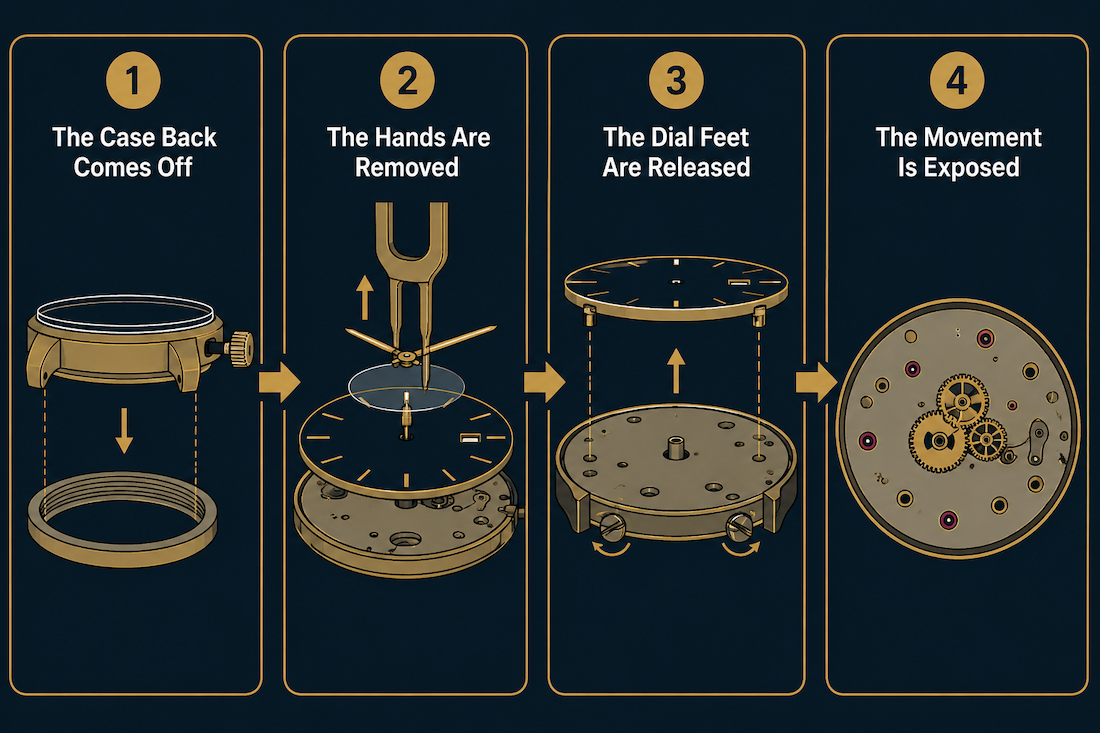
Step 1: The Case Back Comes Off
Before the dial can be accessed, the case back must be opened and the movement freed from the case. This usually involves releasing the crown and stem, then carefully lifting the movement out. On water-resistant watches, gaskets should be inspected at this point. Any time a case is opened, a pressure test should be part of reassembly.
Step 2: The Hands Are Removed
The hands must come off before the dial. A watchmaker uses hand-removal levers or a specialized presto tool to lift them from their arbors. A dial protector prevents scratching or marking. The second hand comes off first, followed by the minute and hour hands together. Removing hands without proper tools can bend them, crack lume plots, or scratch the dial.
Step 3: The Dial Feet Are Released
With the hands off, the watchmaker locates the dial screws or lever mechanisms on the edge of the movement. Loosening these releases the dial feet from their seats. The dial is lifted straight up, carefully and evenly, to avoid bending the feet or dragging the dial across the movement surface.
Step 4: The Movement Is Exposed
Once the dial is off, the full upper surface of the movement is visible. The watchmaker can inspect the motion works, check for wear or corrosion, and begin disassembly if a full overhaul is planned. From this point forward, the movement must be protected from dust, moisture, and unintended contact.
Pro Tip
Bent or broken dial feet are common on watches previously serviced at non-specialist shops. If the feet are damaged, the dial can shift over time and the hands can misalign with the hour markers.
What Can Go Wrong if This Is Done Poorly
Dial removal is routine for a trained watchmaker, but the margin for error is small. Some problems show up immediately. Others take weeks or months to surface.
| Risk | What Causes It | What You Might Notice |
|---|---|---|
| Dust contamination | Working without proper dust covers or in an uncontrolled environment | Intermittent stopping or reduced accuracy over time |
| Scratched dial | Removing hands without a dial protector or using improper tools | Visible marks near the center of the dial |
| Bent dial feet | Forcing the dial off before fully releasing the locking mechanism | Dial shifts; hands no longer align with markers |
| Damaged hands | Incorrect tool pressure or pulling hands at an angle | Bent second hand, loose lume, or hand dragging |
| Fingerprints on movement | Handling without finger cots or proper technique | Corrosion spots on plates or bridges months later |
| Misaligned reassembly | Rushing the hand-setting process or skipping clearance checks | Hands catch each other at certain times of day |
A watch that runs perfectly at pickup but develops intermittent stopping six months later may be dealing with contamination introduced during an earlier service.
Why Environment and Tools Matter
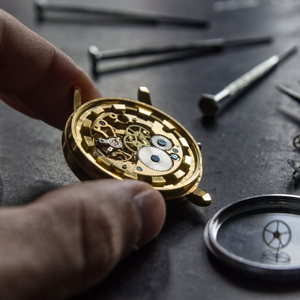
A professional watch workshop is set up to minimize risk. The work surface is clean and covered with a soft, non-abrasive mat. Dust covers protect movements when they are not being actively worked on. The watchmaker uses finger cots or gloves to prevent skin oils and moisture from reaching components. Specialized hand-removal tools, dial protectors, and anti-magnetic tweezers are standard equipment.
This is part of what separates a dedicated watch repair shop from a shop that handles watches alongside other types of jewelry work. At a watch-only workshop, every tool and process is built around handling movements and dials safely. At It’s About Time Inc., every service involving an opened movement is performed in a controlled workshop environment. Applicable water-resistant watches are pressure tested after reassembly.
When Does Your Watch Actually Need Dial Removal?
Not every service requires dial removal, and a good watchmaker will not remove the dial without a reason.
| Service Type | Dial Removal Needed? |
|---|---|
| Battery replacement | No |
| Strap or bracelet change | No |
| Crystal replacement | Sometimes, depending on case construction |
| Pressure testing only | No |
| Full movement overhaul | Yes |
| Dial refinishing or replacement | Yes |
| Hand replacement | Yes |
| Movement diagnosis for accuracy issues | Often |
Pro Tip
With a vintage or collectible watch, your watchmaker should understand the value of preserving the original dial. Unnecessary handling or careless reinstallation can affect both appearance and long-term value.
Reassembly: Putting It All Back Together
Reassembly reverses the process, but it is not simply a matter of doing everything backward. The dial is positioned over the movement with its feet aligned to their corresponding holes. Locking screws or levers secure the feet, and the watchmaker checks that the dial sits flat with no gaps or wobble.
The hands are pressed onto their arbors using a hand-setting tool. The hour hand goes on first, followed by the minute hand and then the second hand. Each hand must clear the dial and the other hands at every position around the dial. The watchmaker advances the time through a full 12-hour cycle before the movement returns to the case.
Once cased, the crown and stem are reconnected, gaskets are inspected or replaced, and the case back is sealed. Water-resistant models then go through pressure testing to verify that the seals are intact.
The Bottom Line on Watch Dial Removal
- Dial removal exposes sensitive parts of a watch to potential contamination and damage.
- The process requires specialized tools, a controlled environment, and a trained watchmaker.
- Problems from poor dial work may not appear immediately, making them difficult to trace to the service that caused them.
- Not every service requires dial removal. A qualified shop should explain when and why it is necessary.
- For vintage and collectible watches, how the dial is handled can directly affect long-term value.
Frequently Asked Questions
Is removing a watch dial risky?+
Dial removal carries real risk when done improperly because it exposes the movement to dust, moisture, and physical contact. A trained watchmaker with proper tools in a clean environment minimizes those risks significantly.
Can I remove my own watch dial at home?+
It is technically possible on some watches, but not recommended. Without a controlled environment, hand-removal tools, and dial protectors, the risk of scratching the dial, bending hands, or introducing dust into the movement is high.
How do I know if my watch was reassembled correctly after service?+
At 12:00, all hands should point straight up without odd overlap. Advance the time through a full cycle and check for catching or dragging, then monitor timekeeping over the first several days.
Does a battery replacement require dial removal?+
No. A standard battery replacement accesses the movement from the case-back side and does not require removing the dial or hands. If a shop says dial removal is needed for a battery swap, there may be a separate issue to diagnose.
What is the difference between dial feet and dial screws?+
Dial feet are small metal pins on the back of the dial that fit into holes on the movement’s main plate. Dial screws, or sometimes a sliding lever, hold those feet in place and keep the dial precisely positioned.
Why does my watch keep stopping months after a service?+
Intermittent stopping after service can have several causes. One common one is dust contamination introduced while the dial or case back was open. Even a single fiber or particle can interfere with a gear tooth or balance-wheel pivot.
Talk to a Watchmaker
If you have concerns about dial damage, hand alignment, timing accuracy, or a service recommendation, our workshop team can help. Visit our Johns Creek showroom or call to speak with a watch specialist.