A careful guide to deciding whether an aging watch dial should be refinished, replaced, or preserved exactly as it is.
Key Takeaways
- ✓Dial refinishing restores the existing dial surface without replacing it . It works best for fading, discoloration, light scratches, and worn printing.
- ✓Dial replacement swaps the original dial for a new one . It is typically necessary when there is structural damage, severe corrosion, or irreparable water damage.
- ✓For vintage or collectible watches, keeping the original dial (even in imperfect condition) almost always preserves more value than refinishing or replacing it.
- ✓A qualified watchmaker should inspect the dial in person before recommending either option . The right answer depends on the watch, its history, and your goals.
Your watch dial is the first thing you see every time you check the time. When it starts showing signs of wear, fading, or damage, the question is straightforward: can it be restored, or does it need to be replaced? The answer depends on the type of damage, the watch itself, and what you want to preserve. This guide walks you through both options so you can make the right call before any work begins.
What Is Watch Dial Refinishing?
Watch dial refinishing is the process of restoring a dial’s original appearance by stripping, recoating, and reprinting the existing dial surface without replacing it.
A skilled technician strips the existing finish down to the base metal, applies a new surface coating to match the original color and texture, reprints any text or branding using a plate made from the original design, and reapplies luminous material to the markers if applicable.
The result, when done well, is a dial that looks close to its original factory condition. The key phrase is “when done well.” Dial refinishing is a specialized craft that requires precise equipment, correct font libraries, and experience with specific finishes. Not every watchmaker offers this service, and not every shop that offers it does it at the level a luxury watch demands.
Pro Tip
If your watchmaker cannot show you examples of previous dial refinishing work on a similar brand or dial type, that is a strong signal to look elsewhere. Refinishing a sunburst Omega dial and refinishing a matte Rolex dial are very different jobs.
What Is Watch Dial Replacement?
Watch dial replacement is the complete removal of the original dial and installation of a new, compatible dial in its place.
The replacement dial must be compatible with the watch’s movement, meaning the dial feet position, center hole diameter, and date window alignment all need to match precisely.
For luxury watches, the replacement dial should be a genuine manufacturer-sourced part. Aftermarket dials exist, but installing one on a luxury timepiece can compromise its authenticity, void manufacturer warranties, and reduce resale value. Rolex, for example, states in its warranty policy that coverage does not apply to watches modified with non-genuine parts or components, including dials.
Replacement is the more invasive option. It gives you a factory-fresh look, but you lose the original dial permanently.
Dial Refinishing vs. Dial Replacement: Side-by-Side Comparison
The table below breaks down the key differences between refinishing and replacement to help you quickly identify which option fits your situation.
| Factor | Dial Refinishing | Dial Replacement |
|---|---|---|
| What it does | Restores the existing dial surface | Removes the old dial and installs a new one |
| Best for | Fading, discoloration, light scratches, worn printing | Severe corrosion, structural cracks, irreparable water damage |
| Original dial retained? | Yes (modified) | No (replaced entirely) |
| Impact on vintage/collectible value | Can reduce value if originality is a priority | Almost always reduces value for collectible pieces |
| Impact on daily-wear watches | Often the best balance of appearance and cost | Can be worthwhile when the dial is beyond refinishing |
| Turnaround | Often 2 to 4 weeks, but varies by shop, dial complexity, and whether work is in-house or outsourced | Varies by parts availability; manufacturer-sourced dials may take longer |
| Risk if done poorly | Mismatched fonts, color inconsistency, reduced value | Incompatible dial feet, date misalignment, loss of authenticity |
When Refinishing Is the Right Call
Refinishing makes sense when the dial’s structure is intact but the surface has deteriorated. Common scenarios include:
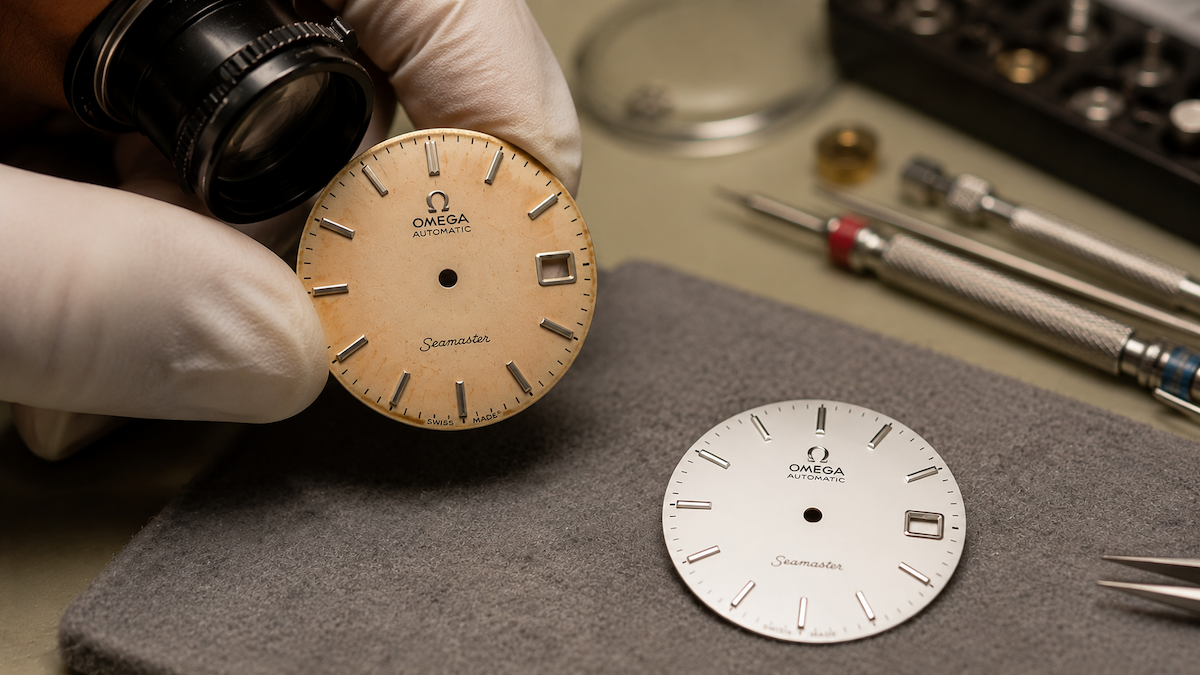
Faded or discolored dial: Sun exposure over years can bleach colors and dull printed text. If the underlying metal is in good shape, refinishing can bring the dial back to its original appearance.
Worn or flaking printing: Brand logos, hour markers, and minute tracks can wear away over time. A refinishing specialist creates a printing plate from the original design and reapplies the text and markings.
Light surface scratches: Superficial marks on the dial surface that do not penetrate the base metal can often be corrected during the refinishing process.
Luminous material has degraded: Older watches frequently need their lume reapplied. This is typically done as part of a refinishing job when the original luminous paint has crumbled or discolored.
When Replacement Is the Better Option
Some damage goes beyond what refinishing can correct. Replacement is typically the better path when:
Water has corroded the dial: Moisture inside the case can cause oxidation, pitting, and rust that eats into the base metal. If the dial surface is bubbled, warped, or structurally compromised, refinishing cannot restore it safely.
Dial is cracked or bent: Physical impact that deforms or fractures the dial makes refinishing impractical. The base must be structurally sound for any surface treatment to hold.
Markers or indices are missing: Applied markers (the raised metal hour indicators on many luxury dials) that have fallen off may be difficult or impossible to source individually. In some cases, a new dial with factory-installed markers is the cleaner solution.
Previous refinishing was done poorly: If an earlier refinishing job used incorrect fonts, wrong colors, or misaligned printing, starting fresh with a genuine replacement dial may be preferable to trying to correct someone else’s work.
Pro Tip
If your watch stopped working and you suspect water entered the case, do not wait. Corrosion starts immediately and can damage both the dial and the movement within days. Bring the watch in for inspection as soon as possible. At It’s About Time Inc., we diagnose dial, crystal, and crown issues before recommending any service.
Refinish or Replace?
Bring your watch to It’s About Time Inc. for a professional inspection. We diagnose before we recommend, and we will explain your options clearly before any work begins.
Start a Repair Form
The Vintage Watch Question: Should You Touch the Dial at All?
This is where the decision gets more nuanced. In the collector market, the original dial is widely considered the most valuable single component of a vintage watch. Industry experts and auction specialists have noted that a watch with original parts, especially the dial, often commands significantly higher value than one with replacements. Some vintage watch appraisers estimate that the dial accounts for the majority of a collectible watch’s value.
The general guidance among experienced watchmakers and collectors is straightforward: if the dial is legible and structurally sound, leave it alone. Patina, which includes the natural aging and discoloration that develops over decades, is increasingly seen as desirable rather than something to fix. In certain collector segments, patina actively increases value. Vintage Rolex Submariners with “tropical” dials, where the original black has faded to warm brown tones over decades, routinely command premiums of $30,000 to $100,000 or more at major auction houses like Phillips, Christie’s, and Sotheby’s. That premium exists specifically because the dial was never refinished or replaced.
It is worth noting that this guidance reflects collector market norms rather than a universal rule. The specific model, era, condition, and buyer pool all influence whether originality carries a premium for any given watch.
That said, not every vintage watch is a collector’s item. If the watch is a personal timepiece you wear daily and the dial’s condition bothers you, refinishing or replacement is a valid choice. The key is making that decision with full awareness of the tradeoff.
If you own a vintage Rolex and are weighing your options, our guide on choosing between vintage Rolex restoration and modern servicing covers the broader restoration decisions in detail.
What Affects the Cost?
Several factors influence what you will pay for either service:
Dial Complexity
A simple single-color dial with printed indices costs less to refinish than a sunburst finish, a two-tone design, or a chronograph dial with multiple subdials. Each additional color, texture, or complication adds time and materials to the process.
Brand and Parts Availability
Manufacturer-sourced replacement dials for brands like Rolex, Omega, or Cartier can be expensive and may have lead times. Generic or discontinued dials may be difficult to source at all, which sometimes makes refinishing the only practical option.
Watch Age and Rarity
Older watches may require more careful handling, and rare references may have unique dial configurations that complicate both refinishing and replacement. A specialist who has worked with the specific brand and era will produce better results than a generalist.
How to Choose the Right Option for Your Watch
The right path depends on your goals and the watch itself. Here is how to think through it:
If you want to preserve value on a collectible piece: Leave the original dial intact unless it is structurally failing. Even significant fading or patina is preferable to a refinished or replaced dial in most collector markets.
If you wear the watch daily and the appearance matters to you: Refinishing is usually the best balance of cost, turnaround, and result, provided the dial’s base metal is in good condition.
If the dial has water damage, cracks, or structural issues: Replacement with a genuine manufacturer-sourced dial is typically the right move. Refinishing cannot fix what is broken underneath the surface.
If a previous refinishing job was botched: A genuine replacement dial will restore proper appearance and authenticity. Trying to refinish over poor earlier work rarely produces a satisfactory result.
If the watch has sentimental value but no significant market value: Go with whichever option makes the watch look and feel the way you want. The right choice is the one that keeps you wearing it.
What Happens During a Professional Dial Service
Whether you are having a dial refinished or replaced, the process at a qualified workshop follows a similar sequence. The watchmaker removes the movement from the case, separates the dial and hands, and assesses the condition of every component. If refinishing, the dial goes to a specialist who strips, recoats, reprints, and relumes the surface. If replacing, a compatible genuine dial is sourced, fitted, and aligned. In both cases, the watch is reassembled, tested for accuracy, and pressure tested if applicable before being returned.
At It’s About Time Inc., every dial service is performed in-house by WOSTEP- and Swiss-certified watchmakers. We inspect the dial, explain what we find, and walk you through refinishing vs. replacement options before beginning any work. As a family-owned, watch-only repair and restoration shop in Johns Creek, we have been serving the Atlanta area since 2006.
Pro Tip
Ask your watchmaker whether they work with a dedicated dial refinishing specialist. Dial refinishing is a distinct trade from movement repair. The best workshops either have in-house dial restoration capability or a long-standing relationship with a proven refinishing house.
Brands We Commonly See for Dial Work
In our workshop, certain brands come in for dial services more than others. We regularly see faded dials on vintage Omega Seamasters and Constellations, moisture-related dial damage on Rolex sport models where gaskets were not replaced during prior service, loosened applied markers on TAG Heuer watches after impacts, and cosmetic wear on Cartier Tank and Santos dials. As an authorized service center for Omega, TAG Heuer, Cartier, Jaeger-LeCoultre, NOMOS, Baume & Mercier, Longines, RADO, and Tissot, It’s About Time Inc. has the manufacturer training, tools, and genuine parts access to handle dial work to factory standards. Our watchmakers also hold certifications from Rolex, IWC, Panerai, and Audemars Piguet, giving us hands-on experience across a wide range of luxury references.
The Bottom Line on Dial Refinishing vs. Dial Replacement
- Start with a professional inspection. The right recommendation depends on damage type, watch age, and your goals.
- Refinishing works for surface-level wear: fading, discoloration, worn printing, degraded lume. The base metal must be structurally sound.
- Replacement is the better option for water-corroded, cracked, or structurally compromised dials, and for watches with botched previous refinishing.
- For vintage and collectible watches, originality matters more than appearance. A faded original dial is almost always more valuable than a refinished one.
- Always use a workshop with brand-specific experience. Dial work is specialized, and the results vary significantly based on the skill of the person doing it.
- Insist on genuine manufacturer-sourced parts for any replacement on a luxury watch. Aftermarket dials can compromise authenticity and future serviceability.
Ready to restore your timepiece with precision and care? Our experienced technicians handle everything from simple tune-ups to full mechanical overhauls. Let us bring your watch back to life.
FAQ
What Is the Difference Between Dial Refinishing and Dial Replacement?
Refinishing restores the existing dial; replacement removes it and installs a new one. With refinishing, a specialist strips the old finish, recoats the surface, and reprints the original markings, so the original dial is preserved in modified form. With replacement, the dial is swapped out entirely for a new component. The right option depends on the type and extent of damage to the dial.
Does Refinishing a Watch Dial Reduce Its Value?
It can, especially on vintage or collectible watches where the original dial is a major driver of value. Collectors in those markets strongly prefer untouched original dials, even if faded or imperfect. For modern daily-wear watches with no significant collector premium, a well-done refinishing job can actually improve the watch’s appeal and usability without meaningful value loss.
Can Water-Damaged Watch Dials Be Refinished?
Sometimes, but only if the damage is limited to surface discoloration. Light moisture exposure that caused cosmetic changes may be correctable through refinishing. Severe water damage that caused oxidation, pitting, or corrosion into the base metal usually requires dial replacement instead. A qualified watchmaker can assess the dial’s condition and recommend the right path. If you suspect water has entered your watch case, bring it in promptly to minimize further damage.
Should I Refinish the Dial on My Vintage Watch?
In most collector market contexts, no. Original dials, even those showing significant age and patina, are typically the most valued component of a vintage watch, and refinishing can significantly reduce market value. The exception is when the dial is no longer legible or is structurally failing and the watch is intended for daily wear rather than collection. The model, era, and condition of your specific watch all factor into this decision, so consulting a qualified luxury watch specialist before proceeding is important.
How Long Does Dial Refinishing or Replacement Take?
Refinishing often takes two to four weeks, though timelines vary significantly depending on the shop, dial complexity, and whether the work is handled in-house or sent to a dedicated refinishing specialist. Dial replacement turnaround depends on parts availability. In-stock genuine dials can be installed within days, while manufacturer-ordered parts for luxury brands may take several weeks. Your watchmaker should give you a clear timeline before work begins.
Can Any Watchmaker Refinish a Dial?
No, dial refinishing is a distinct specialty that most general watchmakers do not perform themselves. It requires specific equipment, printing plates, paint formulations, and font libraries that go beyond standard movement repair tools. Most watchmakers send dial refinishing work to a dedicated specialist. When choosing a shop, ask whether they have in-house dial refinishing capability or a proven relationship with a specialist refinishing house.